Supreme Court ruling: when is a Home Office illegal working penalty invalid?
 |
ross@vanessaganguin.com +44 (0) 20 4551 4897 +44 (0) 7894 790890 |
|
ross@vanessaganguin.com +44 (0) 20 4551 4897 +44 (0) 7894 790890 |
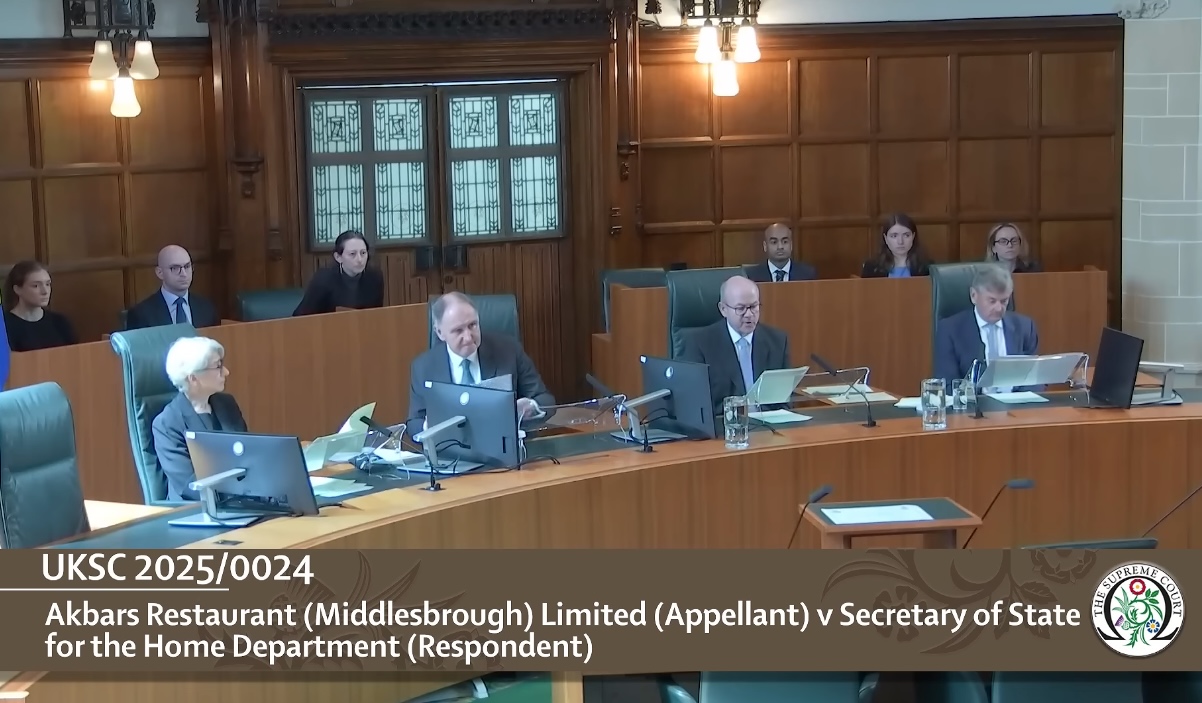
The Supreme Court has ruled that a Home Office civil penalty notice for illegal working was invalid because it did not clearly explain why the employer was said to be liable.
In Akbars Restaurant (Middlesbrough) Limited v Secretary of State for the Home Department, the Home Office issued a £15,000 penalty after deciding that the restaurant had employed someone who did not have permission to work in the UK. The notice listed several possible reasons why a person might not be allowed to work but did not say which reason applied in this case.
The court held that this was not good enough. Employers must be told, in the penalty notice itself, the specific basis on which the Home Office says they are liable. Without that information, an employer cannot properly decide whether to object, appeal or pay the penalty.
The court held that an employer shouldn’t have to appeal just to find out: later documents in the proceedings can’t cure the defect.
The decision may affect other illegal working penalties if the Home Office has used similar wording in its notices. Employers who receive a civil penalty should check whether the notice clearly identifies the alleged breach, rather than simply referring to the general illegal working rules. Where the alleged breach has not been identified, it may be possible to challenge the penalty on that basis.
This does not remove the need for employers to carry out proper right to work checks. If there has been a breach, the Home Office may be able to issue a new, valid notice. The case is a useful reminder that employers should keep clear records of right to work checks and seek advice quickly if they receive a penalty.
What should employers do if they receive a civil penalty notice?
The clock starts immediately: recipients have 28 days from the due date specified in the notice to either pay the penalty in full, arrange an instalment plan or submit an objection. Once that window closes options become more rigid, more expensive and less predictable.
Within that period, an employer should:
- Read the notice carefully and diarise the deadlines. The notice will set out the alleged breach, usually with a breakdown of each worker’s alleged status, whether it’s treated as a first or repeat breach, and what steps the Home Office says they took that fell short of a statutory excuse. Following the Supreme Court ruling, it’s worth checking whether it identifies the specific statutory basis for the penalty.
- Assess liability and gather evidence fast. Pull together the right to work check records for the individual(s) concerned: copies of documents checked, dates, who conducted the checks, online share codes, etc. The grounds for objection are generally: you are not liable (e.g. there is no employer-employee relationship); you have a statutory excuse because compliant checks were done, or the penalty amount has been miscalculated.
- Decide whether to pay a civil penalty or object. For first breaches a fast payment option may be available, offering a 30% reduction if the full amount is paid within 21 days of the notice date. Objecting isn’t risk-free: objections can lead to the penalty being upheld, cancelled, reduced or increased. Objecting means losing the original fast payment discount, but a new 21-day fast payment period applies if the penalty is maintained. However, objecting preserves a right to appeal later and prevents the penalty becoming enforceable while the objection is considered.
- Be aware of serious consequences for sponsors. A civil penalty can lead to a sponsor licence investigation and potential suspension, downgrade or revocation. These can be much more business critical for employers relying on sponsoring workers than the penalty itself.
Given the sums involved (up to £45,000 per worker for a first breach, £60,000 for repeat breaches), taking legal advice early in the 28-day window is usually money well spent.
Whatever the outcome, a reliable immigration practitioner should also be able to help audit and review right to work processes to protect against the risk of a further penalty.
If the Home Office maintains the penalty after considering the objection, employers can appeal to the County Court (or Sheriff Court in Scotland), usually within 28 days of the Objection Outcome Notice.
What should an employers do if a civil penalty notice didn’t specify the nature of a breach?
The Supreme Court has held that a penalty notice under section 15 of the Immigration, Asylum and Nationality Act 2006 was invalid because it didn’t state the specific basis on which the Home Secretary considered the employer liable. In the case of Akbars Restaurant, the notice simply listed all the reasons available rather than identifying which was relied upon.
Employers who believe a notice recites section 15(1) of the Immigration, Asylum and Nationality Act 2006 wholesale without pinning down the specific allegation would do well to seek legal advice. They should:
- Raise the invalidity point at the outset, within the objection deadline. Frame the objection (and any subsequent appeal) around the notice’s non-compliance with section 15(6)(a), citing Akbars.
- Don’t treat it as a get-out-of-jail-free card. The decision doesn’t weaken the obligation to carry out and retain compliant right to work checks. Where there has in fact been a breach, the Home Office can simply issue a new, valid notice.
- Keep the substantive defence ready in parallel. As the Home Office may reissue a penalty notice, the smart approach is to run the invalidity argument alongside evidence of statutory excuse or non-liability, if possible, rather than relying on the technical point alone.
What are the chances of a penalty appeal succeeding?
The Home Office doesn’t publish objection or appeal success rates, so there is no official data. Historically, the gap between penalties issued and sums actually collected has been very large. Only around a third of penalty value were ultimately recovered, though we do not know how much of that is due to reductions, cancellations or simple non-payments.
Experience tells us that a focused objection that secures a cancellation or reduction of penalties is generally much less disruptive than court appeals, so good legal advice is essential from the very start.
Success depends on the facts of the case. The Home Office applies what is effectively a strict liability test: if the worker lacked permission and an employer does not evidence a compliant right to work process, liability follows without a statutory excuse. The best protection an employer can have is paperwork evidencing compliant right to work checks. If in doubt, seek out an immigration adviser.
Ross Kennedy has built a reputation for himself as a safe pair of hands across the wide range of challenges of personal and business immigration. He is a regular participant of the Immigration Law Practitioners Association (ILPA) Economic Migration Working Group and a contributing author for Lexis PSL, as well as writing about immigration law developments for other legal and national publications.
Photograph (c) The Supreme Court